


Climate Deal Draft Revealed: Exclusive, Best Hope Yet
📅 2025-11-22
✍️ Editor: Sudhir Choudhary, The Vagabond News
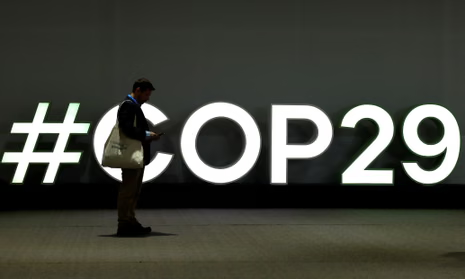
In a dramatic pre-dawn development that negotiators privately hailed as “the moment the pieces finally clicked,” the latest climate deal draft was quietly uploaded to the UN Framework Convention on Climate Change (UNFCCC) website around 3 a.m. Friday, after talks stretched well past 9 p.m. Thursday. The document, which delegates informally called the best hope yet of bridging divides between major emitters and climate-vulnerable nations, marks a pivotal step toward a consensus outcome at this year’s summit. Even as capitals analyze the legal language line by line, the draft’s architecture—finance, mitigation, adaptation, and transparency—signals a serious push to convert years of ambition into implementation, and, crucially, to make that implementation bankable and trackable. Observers described it as the clearest map so far for moving from “what” to “how,” and from “when” to “now,” with the spirit of threading through the text as negotiators hunt for a landing zone.
Key takeaways at a glance
– The draft sketches an explicit pathway toward a global transition away from unabated fossil fuels, with a strengthened timeline for power sector decarbonization.
– It proposes a scaled-up climate finance package, including a framework to broaden the contributor base and catalyze private capital at lower cost of borrowing.
– It advances a global adaptation goal with measurable targets and a methodology for tracking progress in climate-resilient development.
– It offers clearer guardrails for carbon markets, designed to restore credibility while protecting environmental integrity.
– It sets out a strengthened transparency regime, with standardized reporting to enable comparability and trust.
Mitigation: a decisive nudge toward a fossil fuel inflection point
While earlier drafts skirted explicit language on fossil fuels, the new text acknowledges that keeping 1.5°C within reach hinges on accelerating the transition away from unabated fossil fuels this decade. It includes options that call for tripling global renewable energy capacity and doubling the pace of energy efficiency improvements by 2030, paired with a firm end to new unabated coal capacity. This framing stops short of the maximalist “phase-out” demand backed by a swelling coalition of countries and civil society groups, but it moves beyond compromise phrases of the past—effectively placing the onus on national plans to show tangible pathways, timelines, and policy levers.
Finance: a broader tent and cheaper capital
The draft outlines the first contours of a new collective quantified goal (NCQG) on climate finance that goes beyond the longstanding $100 billion benchmark. Crucially, it invites “all capable parties” to contribute, gently expanding the circle of donors while preserving the principle of common but differentiated responsibilities. A proposed finance delivery mechanism aims to cut borrowing costs for climate-vulnerable economies through partial guarantees and blended finance structures, with multilateral development banks urged to update risk appetites and capital adequacy frameworks. The language is careful—sensitive to sovereignty and domestic politics—but the direction of travel is unmistakable: climate finance must be larger, faster, and cheaper if the transition is to gain traction.
Adaptation and resilience: from pledges to measurable progress
For countries already facing escalating heat, storms, and sea-level rise, the draft’s biggest advance may be the operationalization of the global goal on adaptation. It highlights sectoral milestones—water security, resilient health systems, climate-smart agriculture, and nature-based solutions—with a proposed dashboard for tracking adaptation outcomes, not just inputs. The draft also encourages national adaptation investment pipelines, to ensure projects are finance-ready and to help private investors identify bankable resilience opportunities in infrastructure, food systems, and urban planning.
Loss and damage: early signals on institutional muscle
Following last year’s landmark agreement to establish a loss and damage fund, the new draft gestures toward rapid capitalization through a mix of public contributions and innovative instruments, including debt-for-climate swaps and levies on high-emitting sectors of international transport. While numbers are not locked in, the text suggests a pragmatic route to move money quickly—prioritizing communities hit by slow-onset events like sea-level rise and by climate-fueled disasters where insurance markets routinely fail.
Carbon markets and integrity: closing loopholes, rebuilding trust
The draft proposes tighter quality criteria for carbon credits under Article 6, robust safeguards to prevent double counting, and new transparency requirements for host countries and intermediaries. This is designed to restore confidence after years of concerns over inflated baselines and questionable additionality. The reforms would empower buyers to distinguish high-integrity credits, align corporate claims with real-world emissions reductions, and channel finance to projects that deliver verifiable climate and community benefits.
Transparency and accountability: clearer reporting, stronger peer scrutiny
On transparency, the text moves toward standardized formats and timelines for national inventories and progress reports, enabling apples-to-apples comparisons across parties. It proposes an improved technical expert review process that is supportive but unflinching, with results feeding back into national planning cycles and the next global stocktake. The net effect: a virtuous circle where data drives policy, and policy is judged by data.
What the draft signals now
Diplomats say the new draft is not the final word—options remain bracketed, and ministers will need to close gaps on finance volumes, fossil language, and timelines. Yet the architecture is unusually coherent. By connecting mitigation ambition with real finance delivery and operational adaptation targets, the document answers a critique that has haunted previous COP outcomes: lofty goals without the means of delivery. This time, the means are on the page, with a financing spine that could unlock private capital and align multilateral banks with 2030 imperatives.
The political path ahead
As ministers huddle in closed-door sessions, expect hard bargaining over who pays, how much, and how fast; over whether “transitioning away” from unabated fossil fuels can be strengthened to “phasing out”; and over safeguards to ensure equity for developing economies with minimal historical responsibility. Civil society and vulnerable nations will push to harden timelines and lock in adaptation finance that is predominantly grant-based. Major emitters will weigh domestic feasibility and industrial policy concerns, even as a global clean energy race gathers pace.
Why this draft may be the best hope yet
Three factors explain the cautiously upbeat mood. First, the science and economics increasingly align: clean energy is cheaper and scalable, while climate risks are mounting in real time. Second, the draft bridges the trust deficit by tying ambition to financing tools that can reduce borrowing costs. Third, the transparency upgrades promise to turn pledges into measurable outcomes—an essential step to rebuild confidence among both markets and publics.
If the final deal lands close to this draft, the world will exit this summit with more than rhetoric: a workable plan to narrow the emissions gap this decade, protect the most vulnerable, and fund the transition at speed and scale. The hours ahead will determine whether negotiators can strike the balance between durability and ambition—and whether the spirit of that animated the pre-dawn upload can carry through to the gavel.
News by The Vagabond News


