

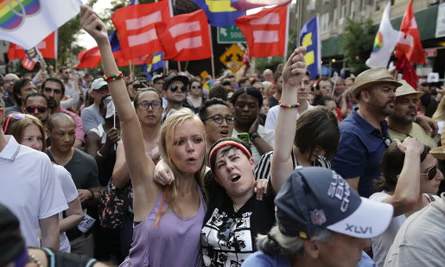
In a quiet yet consequential move that resonated across the nation, the U.S. Supreme Court declined to revisit a case involving same-sex marriage, leaving intact a lower-court ruling and signaling stability for a right that has reshaped American family life over the past decade. For millions of LGBTQ+ Americans, advocates, and allies, the decision functions as a powerful reinforcement: same-sex marriage remains firmly protected under federal constitutional law, and attempts to roll back those rights continue to face substantial judicial headwinds.
The decision comes as new data show that the number of married same-sex couples has roughly doubled in the last ten years. Analysts point to multiple drivers: the maturation of legal protections since the landmark 2015 Obergefell v. Hodges ruling, growing social acceptance, and the economic and legal benefits that come with marriage. While some communities have seen more rapid adoption than others, the national trend line is unmistakably upward.
WHAT THE COURT’S MOVE MEANS FOR SAME-SEX MARRIAGE
The Supreme Court’s refusal to take up the case does not change the existing legal framework; rather, it preserves it. When the justices decline to grant review, the lower-court decision stands, indirectly affirming the prevailing interpretation without issuing a new opinion. For same-sex marriage, that means marital rights and recognitions remain consistent from state to state—marriage licenses continue to be issued, benefits remain accessible, and recognition persists across jurisdictions.
Legal observers note that the Court’s approach here mirrors a pattern seen in other high-profile social questions: if the governing doctrine is well-settled and lower courts are generally aligned, the justices often avoid reopening disputes unless a clear conflict emerges. In this case, the absence of a direct challenge to the core constitutional right—combined with years of reliance by married couples—likely weighed heavily against revisiting the issue.
A DECADE OF CHANGE: THE RISE OF MARRIED SAME-SEX COUPLES
Since nationwide marriage equality took effect, same-sex marriage has moved from a contested battleground to an everyday reality. Over the past decade, the number of married same-sex couples has approximately doubled, according to federal estimates and national surveys. Many couples who once waited for legal clarity have since formalized their unions, and younger LGBTQ+ adults now view marriage as both accessible and beneficial.
Beyond the symbolic importance, marriage confers tangible advantages: hospital visitation rights, inheritance protections, parental presumptions, tax and immigration benefits, and spousal coverage for health insurance. These real-world stakes help explain why the trend has accelerated. Employers, insurers, and government agencies have also standardized policies, reducing friction for couples navigating paperwork—from the DMV and Social Security to adoption agencies and schools.
REGIONAL DIFFERENCES AND THE FUTURE OF FAMILY POLICY
Although same-sex marriage is recognized nationwide, the experience of couples can still vary by locality. Some regions offer robust nondiscrimination protections and inclusive services, while others may present administrative or social hurdles. Yet the broader direction is clear: family law, workplace benefits, and public services have increasingly adapted to the reality that same-sex marriage is part of the American family landscape.
Family-policy experts also point to the ripple effects. As marriage rates increase, so too do related legal questions, from parental rights in assisted reproduction to interstate recognition of adoption orders. Courts and legislatures have been methodically updating statutes to ensure same-sex spouses receive equal treatment—a process likely to continue as new issues arise.
WHY THE SUPREME COURT’S SILENCE SPEAKS LOUDLY
By sidestepping a potential reopening of the issue, the Supreme Court has effectively lowered the political temperature around same-sex marriage. With no new legal uncertainty introduced, couples can continue planning their lives—buying homes, starting families, and building businesses—on stable legal ground. That stability matters. When the rules are clear, individuals and institutions operate with confidence, and social conflict tends to ease.
The Court’s move also reflects a reality that cuts across law and culture: same-sex marriage has become woven into the fabric of American life. The doubling of married same-sex couples is not merely a statistic; it is a measure of trust in institutions and of belonging in community. In practical terms, it means more spouses filing joint taxes, more parents picking up children from school under the same last name, and more retirees sharing earned benefits without legal ambiguity.
A SNAPSHOT OF PUBLIC SENTIMENT
Public support for same-sex marriage has climbed steadily over the past decade. National surveys consistently show majority approval, including among younger voters across the political spectrum. This cultural shift has helped defuse once-contentious debates, enabling policymakers and businesses to focus on implementation rather than ideology. While disagreements remain, the center of gravity has moved toward acceptance and equal treatment.
WHAT TO WATCH NEXT
– Implementation: Continued refinement of state and local policies to ensure same-sex spouses receive all benefits and protections, especially in areas like parental recognition and healthcare.
– Workplace benefits: Ongoing alignment of employer policies, particularly for family leave, fertility benefits, and survivor pensions.
– Legal clarity: Courts may address specific questions at the margins—particularly around emerging family structures—without disturbing the core right to same-sex marriage.
CONCLUSION: A STEADY WIN FOR STABILITY
Same-sex marriage celebrates a stunning court triumph not through a sweeping new ruling, but through the Supreme Court’s choice to let the existing legal landscape stand. That restraint offers exactly what families seek most: predictability, dignity, and equality. With married same-sex couples having doubled in the last decade, the nation’s laws and institutions continue to catch up with lived reality. For couples marking anniversaries, planning weddings, or simply going about their daily lives, the message is reassuring: same-sex marriage remains a secure and enduring part of American life, today and for the foreseeable future.
News by The Vagabond News


Leave a Reply